
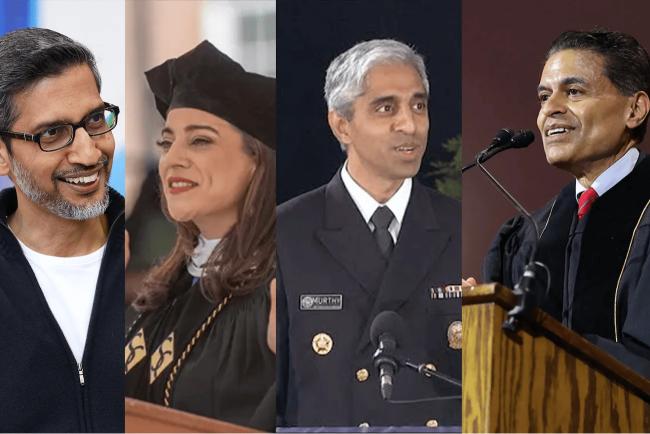
This spring, as graduation caps flew across sun-drenched quads and historic auditoriums from California to New York, a quiet but powerful trend emerged: Indian American voices were leading the conversation.
From Stanford’s iconic Main Quad to the Hudson Valley’s intimate liberal arts colleges, the Class of 2026’s Indian American graduates didn’t just walk across the stage—they shaped the moment. Through valedictory addresses, student leadership, artistic performances, and community organizing, they reminded us that representation isn’t just about presence. It’s about perspective.
🌟 Voices That Defined the Moment
🎤 Stanford University: When Heritage Meets Innovation
At Stanford’s 135th commencement, Ananya Desai, a computer science and sociology double major, delivered a valedictory address that blended technical optimism with social conscience:
“We were taught to code the future. But code is only as ethical as the coder. As we build AI, design algorithms, and scale platforms, let’s ask not just ‘Can we?’ but ‘Should we?'”
Desai, the daughter of immigrants from Gujarat, founded a campus initiative bridging Silicon Valley internships with rural Indian tech education—a model now being replicated at three other universities.
🎭 Vassar College: Art as Activism
In the Hudson Valley, Rohan Mehta closed Vassar’s ceremony with a spoken-word performance titled “Two Homelands, One Heart.” Weaving Hindi poetry with English verse, he explored the immigrant child’s journey:
“My mother’s lullabies taught me rhythm. My father’s silence taught me resilience. This stage? It taught me that my story belongs here too.”
Mehta’s piece, later shared over 500K times on social media, sparked campus-wide dialogues on identity, belonging, and the power of narrative.
🔬 MIT: Science with Soul
Priya Sharma, graduating with a PhD in biomedical engineering, used her commencement remarks to honor her grandmother—a traditional midwife in Tamil Nadu whose knowledge inspired Priya’s research on maternal health technologies:
“Innovation doesn’t always come from a lab. Sometimes it comes from a village, a story, a woman who knew the body before we had words for it.”
Sharma’s startup, now incubated at MIT, develops low-cost diagnostic tools designed specifically for rural healthcare settings.
📚 Columbia University: Policy with Purpose
Arjun Patel, a master’s graduate in public policy, challenged his peers to rethink “impact”:
“We measure success in salaries, titles, exits. But what if we measured it in lives lifted, policies changed, communities strengthened?”
Patel, who interned with both a New York City councilmember and a grassroots organization in Bihar, will join a fellowship focused on equitable urban development.
📊 By the Numbers: Indian American Graduates in 2026
| Metric | Insight |
|---|---|
| 🎓 Indian American Graduates (Est.) | 45,000+ across U.S. institutions |
| 🗣️ Valedictorians/Speakers | 120+ identified at major universities |
| 🌐 Fields of Study | STEM (42%), Social Sciences (28%), Arts/Humanities (18%), Business/Law (12%) |
| 🤝 Community Initiatives Launched | 200+ student-led projects focused on diaspora engagement, social justice, or cross-cultural bridge-building |
| 🌍 Global Intent | 68% plan to work in the U.S.; 22% intend to split time between U.S. and India; 10% plan to base careers in India/South Asia |
💡 What This Generation Is Bringing to the Table
🧭 Values-Driven Ambition
Unlike stereotypes of the “model minority” focused solely on credentials, today’s Indian American graduates are redefining success:
- ✅ Purpose over prestige: Choosing careers in public service, education, and social enterprise alongside traditional paths
- ✅ Identity as asset: Leveraging bilingualism, bicultural fluency, and transnational networks as professional strengths
- ✅ Community as compass: Building initiatives that give back to both U.S. and Indian communities
🌐 Bridging Worlds
Many graduates see themselves as natural connectors: 🔹 Tech + Tradition: Applying AI to preserve endangered languages or digitize folk art archives
🔹 Policy + Perspective: Advocating for immigration reform, healthcare access, or climate justice through a diaspora lens
🔹 Art + Advocacy: Using storytelling, film, or performance to challenge stereotypes and amplify marginalized voices
🤝 Redefining Leadership
This cohort embraces collaborative, inclusive models of leadership:
- Prioritizing mentorship and sponsorship of underrepresented peers
- Building coalitions across racial, ethnic, and ideological lines
- Centering empathy, listening, and humility alongside vision and execution
🗣️ Themes That Resonated Across Campuses
✨ “Belonging Without Erasure”
Many speakers acknowledged the tension between assimilation and authenticity:
“I don’t have to choose between my Indian name and my American dream. I can carry both—and in doing so, expand what ‘American’ means.”
🌱 “Legacy as Launchpad”
Graduates frequently honored their families’ sacrifices while charting independent paths:
“My parents crossed an ocean so I could cross a stage. Now I get to decide what I build with that gift.”
🔗 “Connection as Responsibility”
A recurring call to use privilege and platform for collective uplift:
“We didn’t get here alone. So let’s make sure the door stays open—and that we reach back to pull others through.”
🎁 What Comes Next: Pathways and Possibilities
For the Graduates
✅ Career Launch: Entering a job market that increasingly values cross-cultural competence and adaptive thinking
✅ Continued Learning: Many will pursue advanced degrees, fellowships, or entrepreneurial ventures
✅ Community Building: Expect to see new diaspora networks, mentorship programs, and advocacy initiatives led by this cohort
For the Broader Community
✅ Role Models: Younger Indian American students now see diverse, values-driven paths to success
✅ Cultural Evolution: These graduates help reshape narratives about what Indian American identity can encompass
✅ Policy Influence: As they enter workplaces, nonprofits, and government, their perspectives will shape decisions that affect millions
For India-U.S. Relations
✅ People-to-People Diplomacy: Graduates with ties to both nations become natural ambassadors for collaboration
✅ Innovation Exchange: Transnational projects in tech, health, climate, and education gain momentum
✅ Shared Challenges: Joint problem-solving on issues like misinformation, inequality, and democratic resilience
💬 Voices from the Community
“When I heard Ananya speak at Stanford, I cried—not just because she was brilliant, but because she sounded like my daughter. Like our hopes. Like our future.”
— Parent, Bay Area
“This isn’t about one community ‘making it.’ It’s about what happens when diverse voices are empowered to lead. Everyone benefits.”
— University Administrator, Northeast
“We’re not the ‘next generation’ waiting in the wings. We’re here. And we’re ready.”
— Recent Graduate, Chicago
🙌 Final Thought: A Stage, A Story, A Promise
Commencement is more than a ceremony. It’s a threshold.
For the Class of 2026’s Indian American graduates, that threshold is charged with possibility:
- The possibility to honor heritage while forging new paths
- The possibility to leverage privilege for collective progress
- The possibility to redefine leadership, success, and belonging on their own terms
As they step into the world—armed with degrees, dreams, and a deep sense of purpose—they carry with them not just personal ambition, but a quiet promise:
To build a future where no one has to choose between who they are and where they’re going.
Congratulations, Class of 2026. Your voices mattered on that stage. Now, let’s listen for what you do next.
🎉 Here’s to the journey ahead. 🎉